

News
Winds of Change: Looking to the Future of Moyer-Gould Woods
Hits: 957
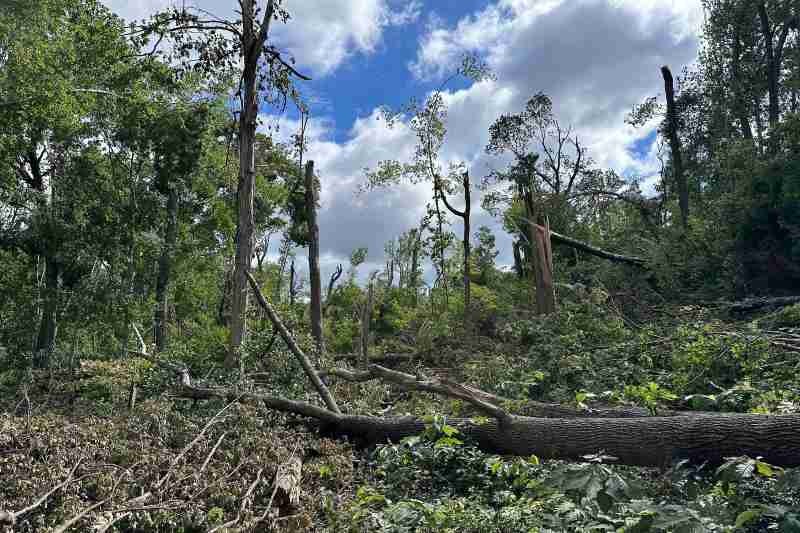
A tornado touched down at Moyer-Gould Woods, leaving toppled trees and broken branches in its wake.
On Thursday, June 11, a confirmed EF-0 tornado passed directly through NICHES’ Moyer-Gould Woods preserve, causing extensive damage and leaving a sea of downed trees, hanging limbs, and unsafe trail conditions. NICHES’ Stewardship Director Bob Easter and volunteer site stewards have made multiple trips to the site to assess damage and begin strategizing for a cleanup.
Moyer-Gould Woods will remain closed to the public indefinitely, until it is deemed safe for access again. Based on preliminary estimates this could take several months. We appreciate your patience and understanding during this time.
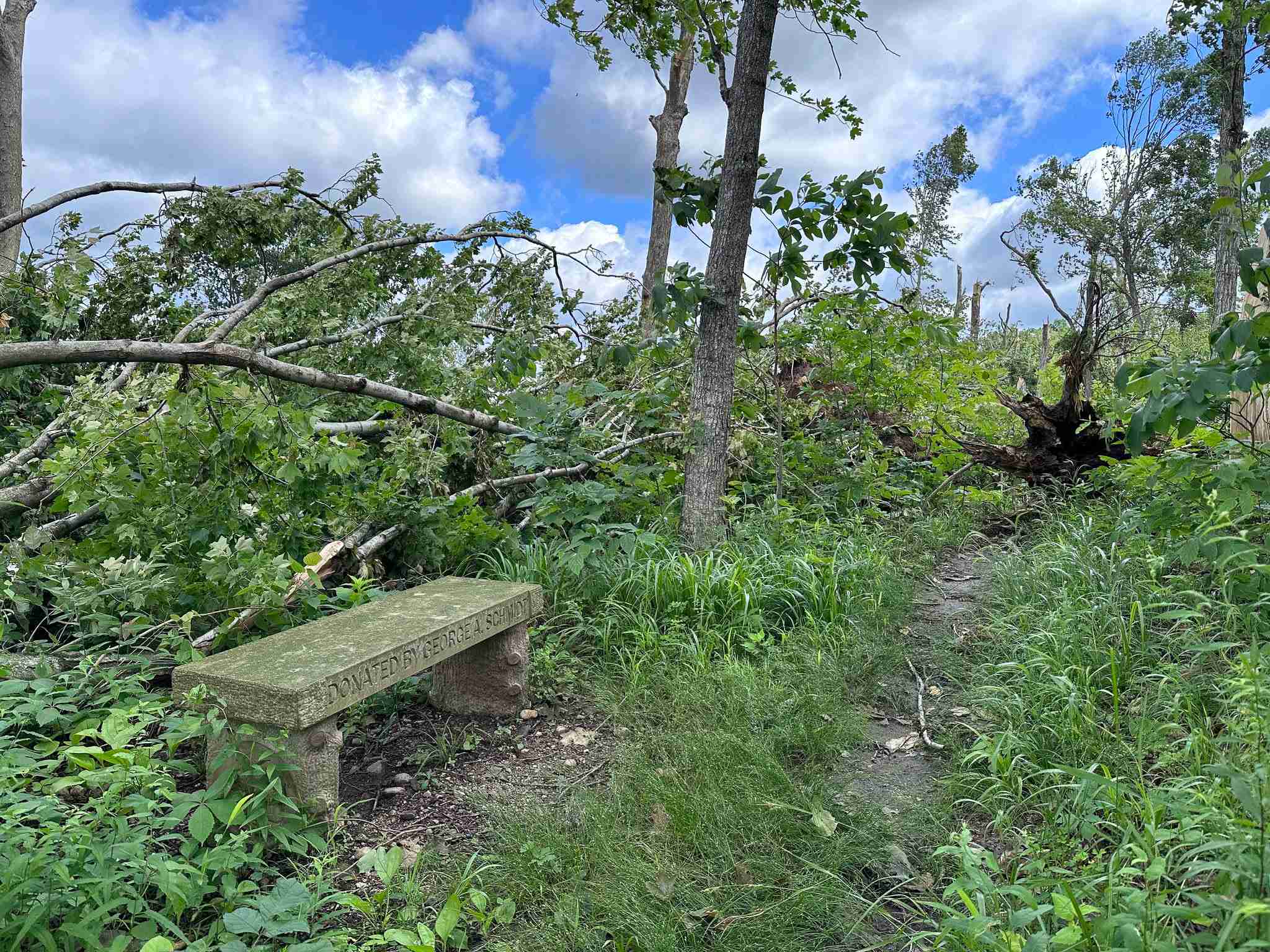
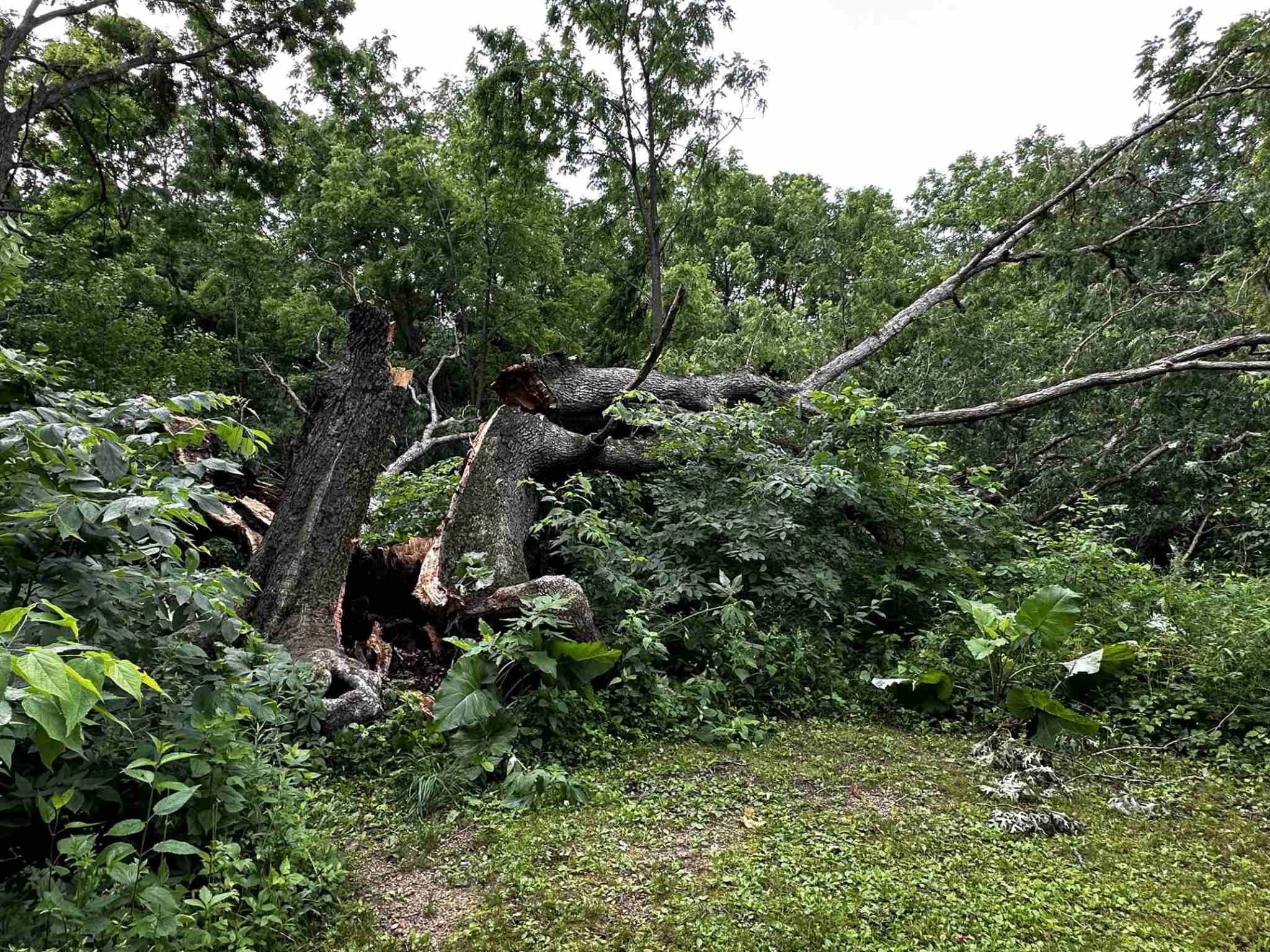
When news broke about the condition of Moyer-Gould, and especially concerning the loss of the beloved “Mother Oak”, we received an outpouring of appreciation for these woods and sadness for the damage it sustained. We also feel this sadness and recognize that this special place will never be the same.
With that being said, we wanted to examine this event in the context of forest health, to hopefully bring some hope back to this preserve.
It is important to recognize that forests are dynamic living systems with countless, interconnected ecological processes happening at once. The relationship between living organisms in a forest is one of both reciprocity and competition, and a healthy system is constantly undergoing change.
Like any living thing, trees have a natural life cycle. They are “born” from seeds, grow into reproductive maturity, complete multiple reproductive cycles, then eventually succumb to disease, old age, or some other natural disturbance and die. Their death returns nutrients back into the system and creates opportunities for new life cycles to begin. Although many trees can live for hundreds of years or longer, no living thing is permanent.
That word, disturbance, is an important one. A forest disturbance can be defined as a random event over time that disrupts forest ecosystems, population structure, and environmental conditions. These disturbances can be biotic (caused by living factors like insects or fungus), or abiotic (caused by non-living factors like fire or, in this case, wind).
As anyone who has lived in Indiana can attest to, strong winds are common throughout the year, especially when associated with extreme weather events. Because of that, windfall is a very important part of our forest’s natural disturbance regime: the frequency, size, and type of disturbance on a given forest landscape. Historically, everything from fire to flooding was part of this regime, but modern practices mitigating these sorts of “natural disasters” have suppressed their impact on our forested lands, leaving wind to do much of the heavy lifting.
Here in Indiana, our woods are highly productive ecosystems, built on the foundation of the trees that make up their forest structure. Trees compete with one another for light, water, and other resources. Trees also control what happens on the forest floor by limiting what sunlight makes it through the canopy.
When trees fall down during a wind event, it changes the local conditions within that habitat. Suddenly, the forest floor is exposed to light for the first time in decades or longer, and new species of plants, formerly suppressed by a lack of light, space, or resources are given room to grow. This can create entirely new levels of localized biodiversity and create unique ecological niches that simply were not there before.
To make a long story short, disturbance is natural and – when experienced or conducted on a scale and frequency following a natural cadence – is actually good for the forest.
Following this type of disturbance, a system that has been “locked” into a certain condition for a long time can experience a burst of new growth and change which can benefit the ecosystem. While it isn’t always pretty, it doesn’t have to be a tragedy.
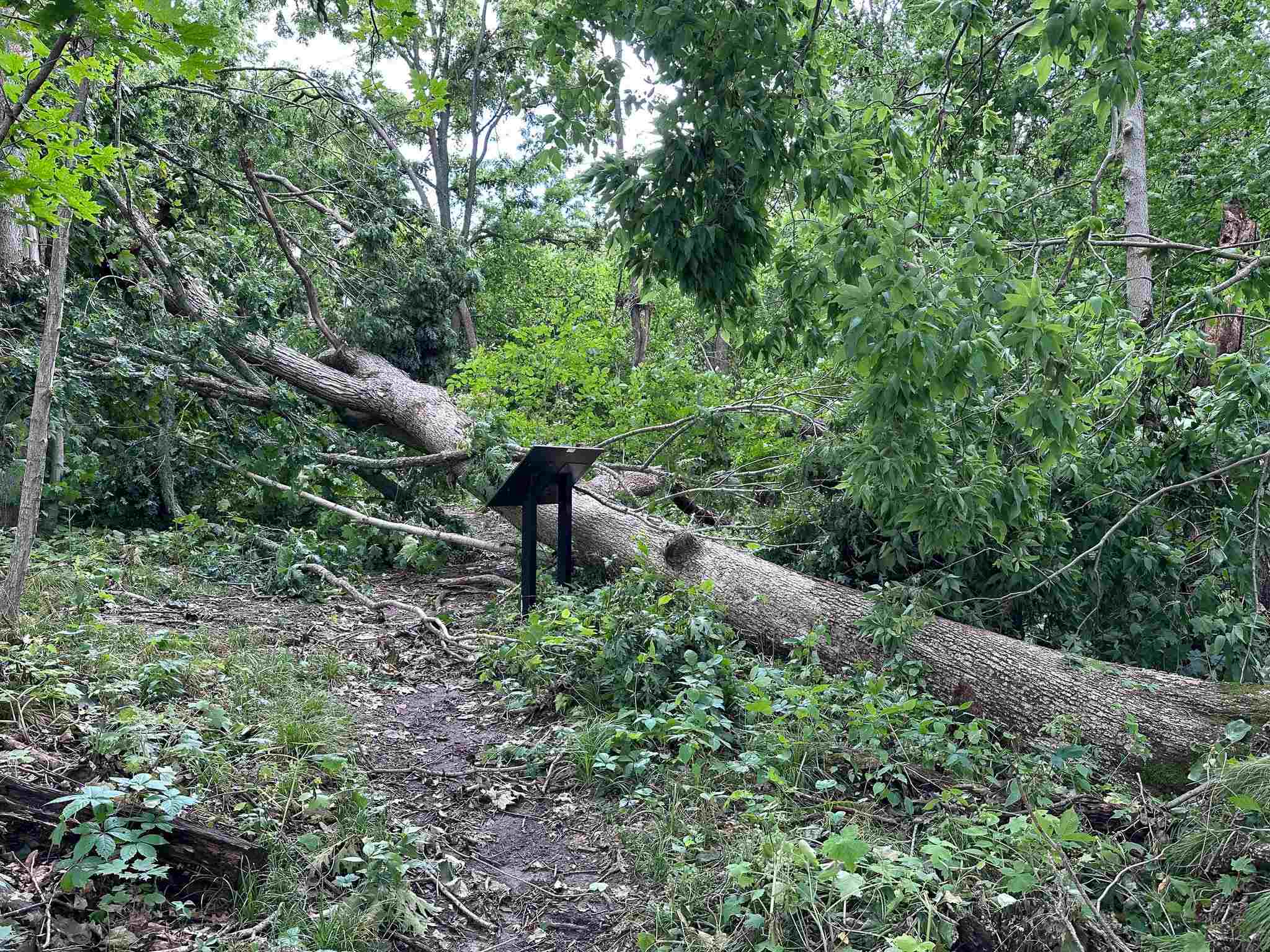
Let’s return to Moyer-Gould Woods and a landscape covered with trunks and tree limbs. The tornado that hit this preserve pressed the ecological reset button on this site. It has created conditions for a bunch of new and interesting biological processes to take place.
NICHES will do our part to ensure that safe public access is restored and help to guide natural regeneration by removing select downed wood where appropriate. Beyond these targeted interventions, we will allow the ecosystem to respond to this natural disturbance through the ecological processes that have shaped forests for centuries. Progress may be slow, but the next evolution of this site has already begun.
Our stewardship staff will closely monitor the preserve, particularly for invasive species that may take advantage of the newly altered conditions. Fortunately, this site has benefitted from years of active management, including invasive species control and the selective thinning of understory, midstory, and some canopy maples to promote oak regeneration. These efforts have helped prepare the forest for natural canopy loss and wind disturbance events such as this one.
The increased light levels and fresh load of leaf litter accumulated from the downed trees may present an opportunity for a fall prescribed fire. Such a treatment could help accelerate the recovery of native grasses, sedges, rare wildflowers, and young oaks. As restoration progresses, we hope to see a diverse community of native plants emerge and thrive, demonstrating the resilience of this ecosystem and the natural processes that sustain it.
As we look to the past to celebrate what once was, we can find solace and even excitement to witness the natural rebirth of our beloved Moyer-Gould Woods Preserve.
1782 N 400 E, Lafayette, IN 47905
(765) 423-1605
niches@nicheslandtrust.org